
Seeing heat is not the same as recognising an object
A thermal imager does not produce an ordinary photograph in the dark. It detects differences in infrared radiation and turns those differences into an image that the eye can interpret. That makes it valuable for observation and navigation, but it also creates a common trap: a visible heat signature can be mistaken for a reliable identification.
Detection means noticing that something warmer or cooler than its surroundings is present. Identification means determining what that thing actually is, with enough confidence to act on the information. A small bright patch may be an animal, a person, a running engine, a sun-warmed surface, or a reflection from another heat source. The device has detected contrast. It has not necessarily supplied an explanation.
This distinction matters in wildlife observation and in legal hunting, where misidentification can have serious consequences. It matters just as much when checking a trail, finding a safe route after dark, or inspecting equipment. Thermal imagery is an aid to judgement, not a replacement for it.
Wildlife can collapse into simple shapes
An animal often appears as a compact warm form against a cooler background. At close range, its outline, posture and movement may provide useful clues. At greater distances, those clues disappear one by one. A deer behind vegetation might become a bright shoulder and head, while a bird on a branch may look like a small irregular spot. A fox crossing an open area can be obvious as a moving heat source but difficult to distinguish from another similarly sized animal once detail is lost.
Heat does not always describe an animal’s silhouette neatly. Fur, feathers and wet surfaces affect the apparent pattern. Parts of a body may be cooler, and vegetation can conceal the shape even when some heat remains visible. An animal facing away may present a very different image from the same animal broadside. Movement helps, but it is not proof; wind-blown grass, drifting leaves and other moving warm or cool objects can also create uncertainty.
For responsible observation, the sensible wording is often “animal-sized warm object” until other evidence supports a more specific conclusion. In a legal hunting context, identification should rely on positively recognising the permitted species and the relevant conditions, using ordinary observation and the rules that apply in the area. If that standard cannot be met, the uncertainty is the important result.
Warm machinery and rocks can look surprisingly alive
Mechanical equipment is a frequent source of convincing false impressions. An engine, exhaust component, bearing, generator housing or recently used vehicle may remain warm after operation. Seen through a thermal device, a machine can present a strong, clean signature with edges that resemble a body. A hot pipe behind a wall or a warm panel in a shed may be visible even though the object itself is hidden.
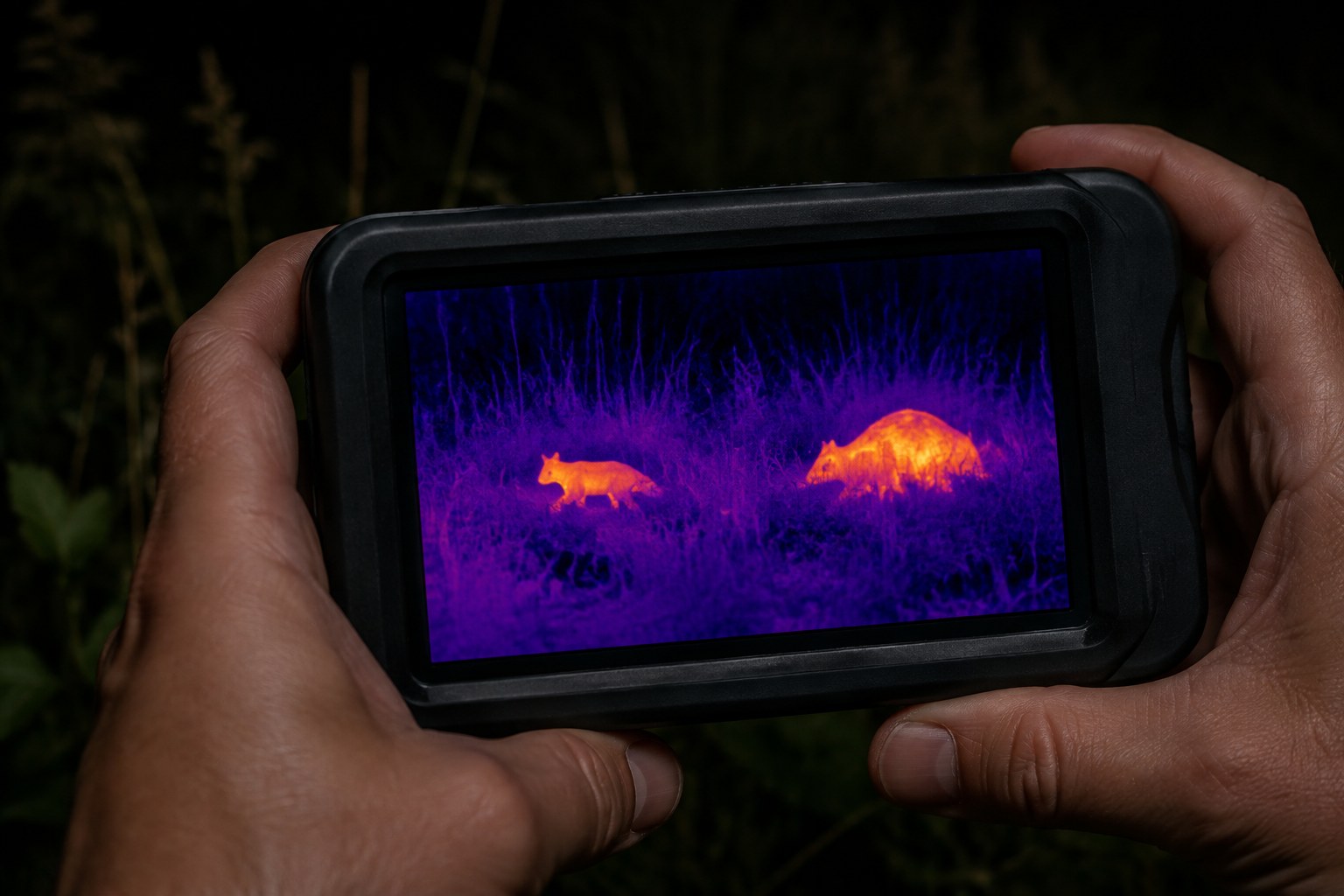
Rocks create a different kind of confusion. A stone exposed to sunlight may retain heat after the air has cooled. Its temperature can differ from nearby ground for hours, depending on its size, colour, moisture and surroundings. A row of warm stones or a sunlit bank may appear as a series of objects. In a changing landscape, those shapes can be mistaken for animals at a glance, particularly when viewed through a narrow field of view.
Context is therefore part of interpretation. A heat source beside a road, building or machine deserves a different reading from one moving naturally across open ground. The image alone may not settle the question, but location, shape, persistence and ordinary visual confirmation can reduce the risk of treating an environmental feature as a living subject.
Reflected heat is not the same as emitted heat
Thermal imagers can show apparent warmth that has been reflected from a surface rather than produced by it. Smooth or shiny materials are especially troublesome because they may reflect nearby heat sources. A metal panel, window, wet surface or polished object can display a patch that seems to belong to the surface while actually echoing warmth from the sky, a lamp, a vehicle or a person standing elsewhere.
Reflections can be misleading because they may have a recognisable shape. A reflected warm object can look like a second object, and a change in viewing angle can make the signature shift or disappear. This is one reason a bright area should not automatically be treated as a hot area. The apparent intensity is not a direct measurement of identity, and it is not always a dependable measurement of surface temperature either.
Looking from another angle, comparing nearby surfaces and checking the scene in ordinary light can help. So can waiting to see whether the shape behaves as an object in the scene or merely changes with the observer’s position. These are modest checks, but they are more useful than assigning certainty to a striking patch of white or red.
Distance, weather and resolution set the limit
Distance reduces more than apparent size. It removes the small temperature patterns that help distinguish one object from another. At a long range, several parts of an animal may merge into one blur, while branches and background clutter can break up the outline. Digital enlargement can make the image larger without restoring the detail that was never captured.
Resolution matters because each image element represents a portion of the scene. If an object occupies only a few elements, its apparent shape and temperature can change sharply with small movements. A higher-resolution image may offer more usable structure, but no device can identify details that distance and atmosphere have erased.
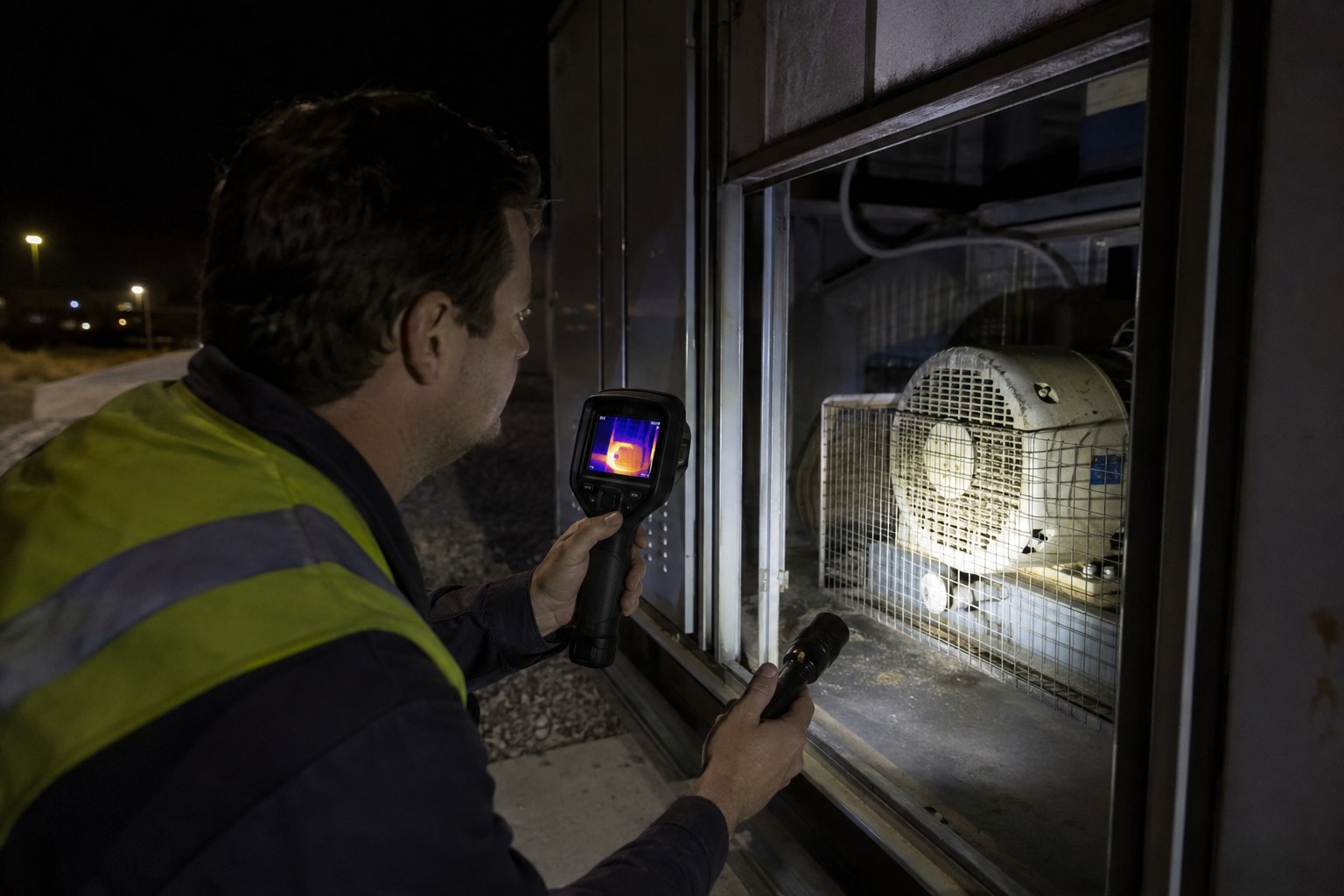
Weather adds another layer of uncertainty. Rain, fog, humidity, snow and wet vegetation can reduce contrast or soften edges. Some conditions obscure the background while leaving a warm object visible, which may create the impression of clarity without providing dependable detail. Wind can move vegetation and alter surface temperatures. Cold, damp conditions can also narrow the difference between an animal and its surroundings.
These limits are not reasons to dismiss thermal equipment. They are reasons to treat its output as a changing measurement of a scene rather than as a finished picture. The more difficult the distance and weather, the more conservative the interpretation should be.
Palette choice changes emphasis, not information
Colour palettes can make thermal images easier to read, but they do not add detail or resolve an uncertain identity. A high-contrast white-hot or black-hot view may make a small warm object stand out. A multi-colour palette can separate temperature ranges and draw attention to the hottest portions of a scene. A more restrained palette may be easier on the eyes during prolonged observation.
The best choice depends on the scene and the observer. A palette that looks dramatic can also exaggerate the importance of a small temperature difference. Bright colours may encourage the eye to focus on the hottest patch rather than the object’s complete form. Switching palettes is useful when the image is ambiguous, but it should be understood as a change in display rather than a second piece of evidence.
Adjusting focus, contrast and the image’s thermal range can be equally important. These controls may reveal an outline that was hidden by the initial settings, or they may expose how easily the appearance changes. If a supposed feature exists only under one aggressive display setting, confidence should decrease rather than increase.
Confirmation belongs in the process
Ordinary observation remains an important companion to thermal imaging. Where conditions permit, use unaided vision, suitable visible-light optics and knowledge of the location to check what the thermal image suggests. Listen for relevant environmental sounds without treating them as conclusive. Observe movement over time. Compare the object with known features nearby. None of these checks is infallible, but agreement between independent observations is stronger than a single bright shape.
For navigation, confirmation may mean establishing whether a warm patch is a person, vehicle, rock or building feature before choosing a safe route. For wildlife viewing, it may mean waiting for a clearer angle rather than disturbing the subject. For legal hunting, it means following local law and identifying the target with sufficient certainty before any action is considered. A thermal device should never be used to justify a guess, and weapon handling should always remain separate from uncertain observation: keep the muzzle in a safe direction, follow applicable safety rules, and do not fire at a heat signature that has not been positively identified.
The most capable observer is not the one who sees a shape in every patch of warmth. It is the one who recognises when the instrument has reached its limit. Thermal imaging is excellent at revealing contrast that ordinary vision may miss. Understanding what that contrast cannot prove is what turns a useful image into responsible information.