
Darkness Changes the Meaning of Familiar Ground
A trail that seems simple in daylight can become an uncertain sequence of edges, gaps, and interruptions after sunset. Night vision does not restore ordinary vision. It presents a processed version of limited information, and the brain must work harder to turn that image into a reliable understanding of the ground ahead.
This matters whether the equipment is being used for lawful wildlife observation, navigation on private land, property checks, or a permitted hunt. The purpose may be different, but the basic responsibility is the same: identify the terrain before committing to a step, and avoid treating an illuminated or amplified image as proof that an area is safe.
Night-vision devices amplify available light, while thermal equipment displays differences in heat. Neither necessarily shows the surface texture, depth, or firmness of every feature. A shallow depression, a loose rock, a wet patch, and a steep drop can appear less distinct than they would in daylight. In some conditions, an object may be easy to notice but difficult to judge.
Depth Perception Becomes an Active Task
Human depth perception normally draws on several overlapping clues: binocular vision, familiar size, texture, shadows, motion, and the way nearby objects obscure distant ones. An optical device can reduce or alter some of those clues. Viewing through a single eyepiece, a narrow display, or a digital image may flatten the scene. Even binocular equipment does not guarantee normal depth perception, particularly when the image is grainy, magnified, monochrome, or affected by glare.
Users should therefore ask more than “What is that?” The more useful questions are “How far away is it?”, “What lies between me and it?”, and “What kind of surface surrounds it?” A branch may be close enough to catch clothing. A pale patch may be a stone, exposed soil, or water. A dark band may be a shallow rut or a change in elevation.
Changing position can help. A small lateral step, taken only when the footing is known to be secure, may reveal whether an apparent line is an edge or merely a shadow. Lowering or raising the viewing angle can also expose contours. These checks take time, but time is usually cheaper than a twisted ankle, a fall, or a loss of orientation.
Contrast Is Useful, but It Can Mislead
Contrast draws attention. A bright object against a dark background is easy to notice, as is a warm animal viewed through thermal equipment. Attention, however, is not the same as understanding. Strong contrast can pull the eye toward one feature while concealing less striking hazards around it.
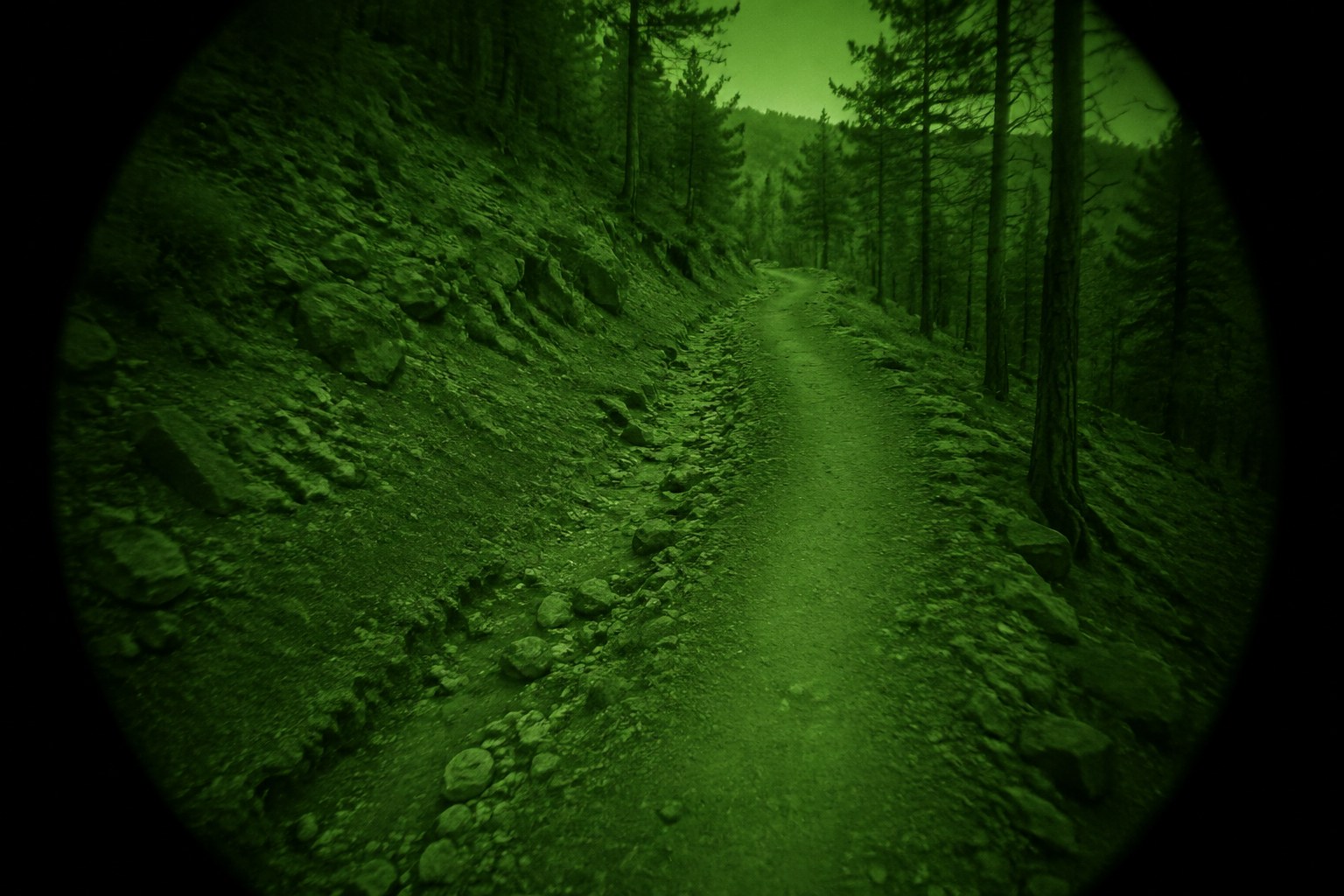
In night vision, branches, grass, and uneven ground may blend together when their brightness is similar. Artificial light can create glare or wash out nearby detail. Thermal images can make living subjects stand out while offering limited information about the exact shape of the ground beneath them. A warm surface, such as a recently used path or sun-warmed rock, may also attract attention without indicating anything about safe passage.
Shadows deserve particular caution. A shadow may hide a drop, a ditch, a low branch, or the edge of a bank. It can also make a harmless rise look steeper than it is. Avoid making a quick judgment from one frame or one viewing angle. Pause, adjust the view, and compare the feature with nearby objects whose size and distance are better known.
Field of View Determines What You Miss
A wide field of view makes it easier to monitor the surrounding scene and maintain a sense of direction. A narrow field of view can reveal more detail at a distance, but it also excludes more of the ground and the space to either side. Magnification increases this trade-off. The more tightly the image is framed, the less useful it is for general movement.
This is why observation and walking should not become the same activity. If the device is being used to inspect a distant animal, an unfamiliar feature, or a possible route, stop first. Keep both the broader surroundings and the immediate footing in mind. Looking only at a central subject can lead to a branch across the path, a hole at the edge of the trail, or a person who has entered the area outside the frame.
Peripheral awareness also matters for lawful hunting and other outdoor activities. Equipment should never be used to identify or track a person as a target, and no shot should be considered where the background, direction, and positive identification are not clear. Local laws may restrict night hunting, artificial illumination, thermal equipment, or the taking of particular species. Equipment does not replace knowledge of those rules.
Scan Slowly and Deliberately
Fast scanning produces the impression of coverage without necessarily producing reliable information. The eye can skip over a narrow gap or fail to register a small change in elevation when the image is moved quickly. Rapid panning also makes it harder to compare one part of the scene with another.
A controlled scan is more useful. Begin with the area immediately around the feet and the next few steps, then work outward toward the route or subject. Move the device in modest sections rather than sweeping continuously. Pause at edges, intersections, slopes, and places where vegetation changes. If something looks unusual, stop scanning and examine it from a stable position.
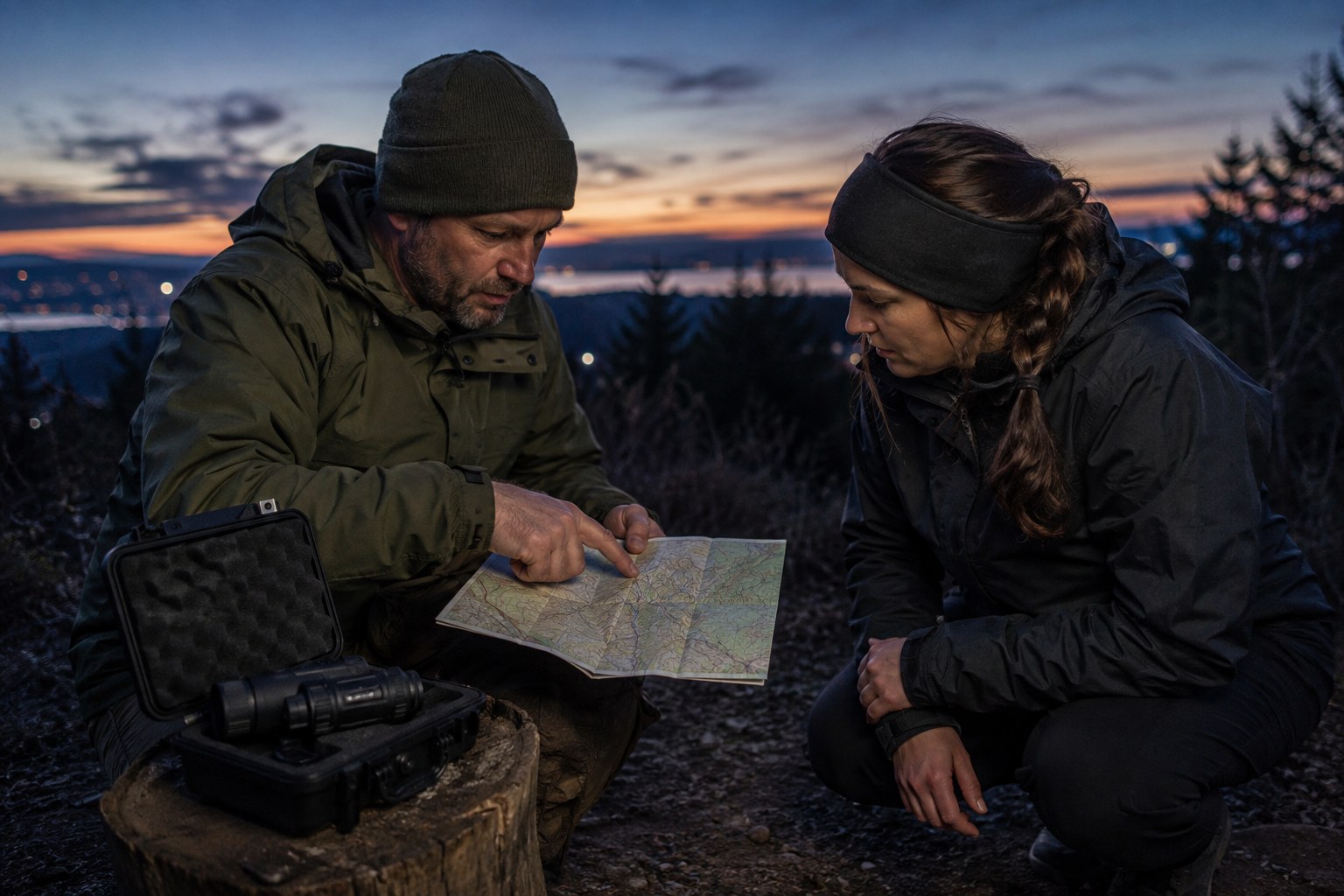
Frequent checks of nearby reference points help preserve orientation. A distinctive tree, fence line, rock, or bend in a trail can provide a visual anchor. It is sensible to glance away from the display at intervals, when conditions allow, so the eyes and balance system are not asked to rely entirely on a small electronic image. Audio cues, known distances, and a companion’s observations can provide useful confirmation, but none should be treated as infallible.
Uneven Ground Calls for a Slower Pace
Walking speed should reflect the quality of the information available, not the confidence created by having equipment. On level, familiar ground with a clear route, a measured pace may be reasonable. On rocks, loose soil, wet leaves, steep slopes, or dense vegetation, the pace should slow substantially. Place each foot deliberately, keep a stable stance, and allow the device to settle before making a judgment.
It is often safer to stop at the top of a slope, before crossing a ditch, or at the edge of thick cover. Check the route in sections. Do not step toward a feature merely because it appears close in the display; the image can compress distance and hide the final change in height. If a route cannot be read confidently, turn back, use a safer path, or wait for better light.
Hands-free movement is not automatically safer. A mounted device can leave both hands available, but it may also keep the user’s attention fixed forward while the feet encounter hazards. Handheld viewing allows the device to be lowered, yet it can interfere with balance or contact with walking aids. The setup should suit the terrain, and a light, stable stance is more important than maintaining a continuous view.
Use the Equipment Within Its Limits
Before heading out, check battery condition, focus, straps, protective covers, and any settings that affect image brightness or display intensity. Practice in daylight and in a controlled, familiar area. Learn how the device represents branches, fences, water, snow, dust, and reflective surfaces. This kind of practice is more valuable than assuming that a clearer display will solve every problem.
Carry ordinary navigation and safety equipment as appropriate for the location. Tell someone where the outing will take place, observe access restrictions, and keep communication available. In hunting contexts, follow all requirements for licensing, seasons, species identification, visibility, firearm handling, and safe backstops. A night-vision or thermal image should never be the sole basis for identifying a person, a legal target, or a safe direction.
The most capable observation device still offers only a partial view of the world. Safe use comes from treating that view as information to interpret rather than permission to move faster. When the terrain becomes uncertain, the correct response is usually simple: stop, widen the assessment, and slow down.